
Object Record
Images
Metadata
Collection |
The Regional Collection |
Object Name |
Clock |
Object ID |
987.041.001 a |
Date |
ca. 1730s-1770 |
Description |
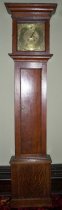
Grandfather Clock. A mid-18th century long case clock made of brass with a long and narrow oak case. The clock mechanism was made by James Wilson of Askrigg, and early English clockmaker. The oak case was probably made by a local craftsman in the same area. The top of the oak case is called the hood and it contains the clock mechanism. The flat top has simple wooden moulding framing the box-like hood. More moulding is attached directly below the clock. The tall and narrow waist has a door fitted onto the front. The door takes up most of the front panel, fitting tightly into it. A small round brass ring attached to a brass disk serves as the handle. The back of the handle has a screw and a two prong closure that fits onto a U-shaped piece of metal attached inside. The squared plinth is wider than the top section. It has more moulding at the top and bottom edges. There is no bottom to the plinth, however each side is thicker for extra support to the free-standing clock. The penfulum and winding mechanism are inside the door of the case. A heavy loop of brass chain extends down from the clock and goes through a cylindrical weight at the bottom, continusing back up to the clock. The long rod with pendulum is behind the chain. Attached to the inside of the case door is a small brown paper repaire tag from an earlier repair. It is currently covered with mylar and held in place by tape. The note reads "Raise the / Pendulum to / make it go / quicker / 15/15/86 Fal" (rest torn off). One of the original documents that came with the clock is a jewellers note. The square base to the clock face is fitted with a brass clock ring and ornate, heavy brass spandrels. The triangular-shaped spandrels are of a floral design, one attached to each corner. The clock ring or dial has two divisions on it, an inner and outer ring. The inner ring is the hourly division in Roman numerals from I to IXX. The outer ring has minute division in increments of 5 to 60. The inner and outer circles are separated by a double row of incised lines with marks corresponding to the hourly divisions. Each arabic numeral corresponding to the hourly division. The outer ring is narrower than the inner ring. The black ornate hands are attached to the center of the clock face. They are a light metal with the hour hand carved with a spade-like scroll design. The minute hand has a scrolled C-shape with a long thin pointer. This type of hand was used up until 1760. Directly below the hands is a cutout arch. Below the arch is a series of vertical lines and numbers. Some clocks had an equation dial to indicate the difference between mean time and sun time. The bottom of the clock ring has the name and location of the clockmaker engraved on its surface. "J. Wilson VII / Askrigg." |
Material |
Oak/Brass/Metal/Screw/Varnish |
Search Terms |
Clock Timekeeping |